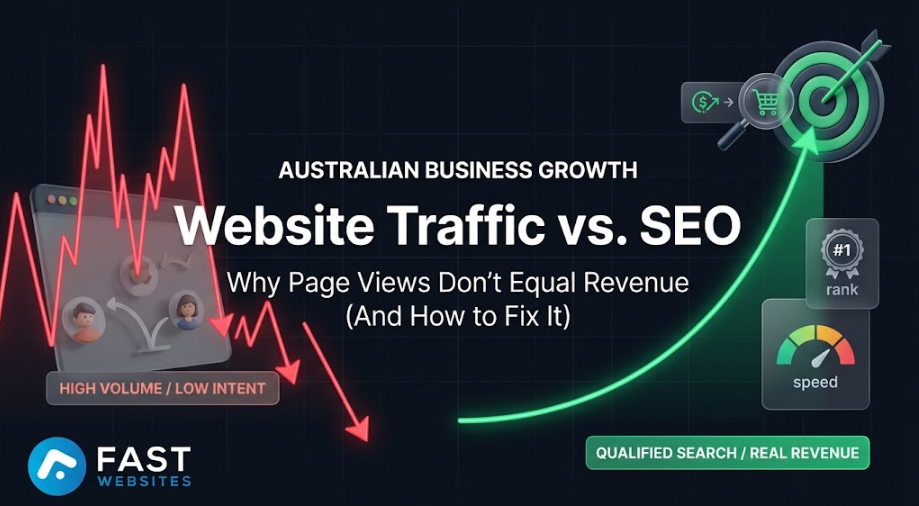
Many business owners treat website traffic and SEO as interchangeable goals. In reality, traffic is a raw metric, while SEO is the sustainable engine that drives qualified, high-intent visitors. Discover the crucial differences between website traffic and SEO, why chasing page views alone is a false economy, and how Australian businesses can turn search visibility into actual revenue.
What Is the Difference Between Website Traffic and SEO?
The short answer: Website traffic measures the total number of visits and page views your site receives across all channels (organic, paid, social, direct, and referral). SEO (Search Engine Optimisation) is the strategic process of improving your site’s technical health, content relevance, and authority so search engines rank your pages higher in organic search results.
In simple terms: Traffic is the count of people who walk through your door; SEO is the long-term system that ensures the right buyers find your door in the first place.
| Metric / Aspect | Website Traffic | Search Engine Optimisation (SEO) |
| What It Is | A volume metric (total visitors & sessions). | A long-term digital marketing & technical strategy. |
| Acquisition Channels | Paid ads, organic search, social media, email, direct visits. | Purely organic search results (Google, Bing, AI engines). |
| Cost Model | Ongoing cost per click (for paid ads) or referral efforts. | Upfront investment in quality build, structure, and content with compounding ROI. |
| Sustainability | Drops instantly when paid ad spend stops. | Continues generating organic leads over months and years. |
| Audience Intent | Varies widely from casual scrollers to accidental clicks. | Highly targeted because users actively search for specific solutions. |
Why High Website Traffic Without SEO Is a Vanity Metric
It is easy to get excited by a spike in analytics. However, 10,000 visitors who bounce in two seconds will generate fewer sales than 200 visitors who landed on your page specifically searching for your services in Darwin or across Australia.
When businesses focus strictly on "traffic volume" without an SEO and performance foundation, three common problems emerge:
Low Commercial Intent: Generic traffic sources (like broad social media ads or clickbait links) attract passive browsers rather than active buyers.
The Paid Ad Treadmill: If your entire traffic flow relies on pay-per-click (PPC) ads, your visitor count drops to zero the second you pause your ad budget.
Wasted Ad Spend: Driving traffic to a slow, unoptimised website produces high bounce rates. As detailed in our breakdown on the opportunity cost of waiting, every second of page lag dramatically increases user drop-offs.
The Core Types of Website Traffic (And Where SEO Fits)
To understand where your revenue comes from, you need to look at how users arrive on your site:
1. Organic Search Traffic (The SEO Driver)
Visitors who discover your business by searching for queries like "web design Darwin" or "commercial plumber near me". According to Google Search Central’s SEO guidelines, organic search prioritises pages that deliver helpful, fast, and technically sound experiences. This is the most valuable traffic because it captures users at the exact moment of commercial intent.
2. Paid Search & Social Traffic (PPC)
Visitors coming through paid campaigns (Google Ads, Meta Ads). While paid ads deliver fast visibility, they require continuous funding. Combining paid campaigns with organic SEO creates a balanced pipeline.
3. Direct Traffic
Users who type your exact URL into their browser or click a saved bookmark. High direct traffic indicates strong brand recognition and repeat business.
4. Referral & Social Traffic
Visitors who land on your website through links on other blogs, news sites, directories, or social media platforms.
How Technical Web Design Bridges the Gap Between Traffic and Conversions
SEO does not stop once a user clicks your link in search results. If your site takes four seconds to render or shifts around while loading, that visitor leaves immediately.
For search engines and AI answer engines, technical performance is a foundational ranking signal:
Mobile-First Responsiveness: With over 60% of Australian web traffic originating on mobile devices, your layout must adapt seamlessly across screen sizes.
Core Web Vitals: Fast server response times, instant visual rendering, and stable layouts keep bounce rates low. (Review our guide on web design speed in Darwin for technical benchmarks).
Clean Information Architecture: Clear navigation paths guide visitors naturally from introductory content to service details, pricing, and enquiry forms.
Local SEO: Why It Matters for Darwin and Regional Australian Businesses
For small-to-medium enterprises operating in regional hubs like Darwin, the Northern Territory, or interstate capitals, broad national traffic is far less valuable than local search visibility.
Local SEO connects your website with geographically targeted queries. You can optimise for local intent by:
Claiming and Verifying Google Business Profile: Keeping opening hours, physical addresses, and contact numbers uniform.
Structuring Schema Markup: Adding local business data so search engines instantly understand your service locations.
Building Fast, Geo-Targeted Landing Pages: Ensuring service pages clearly describe what you do and where you operate.
Actionable Steps: How to Build Sustainable Search Traffic
Audit Your Page Speed: Test your landing pages on Google PageSpeed Insights and remove render-blocking scripts, uncompressed media, and bloated plugins.
Align Content with User Intent: Answer the specific questions your customers ask before buying.
Clean Up Site Architecture: Ensure every primary service page can be reached within two clicks from the homepage.
Prioritise 100% Site Ownership: Avoid closed ecosystems with hidden fees and poor export tools, as explored in our article on the hidden costs of free website builders.
Track the Metrics That Matter: Focus on conversion rate, organic lead volume, and cost-per-acquisition rather than vanity page views.
Stop Chasing Vanity Traffic—Build an SEO Engine That Converts
A high-traffic website is meaningless if visitors leave before taking action. At Fast Websites, we build ultra-fast, mobile-optimised websites engineered for both organic search performance and seamless user conversion—delivered live in just 72 hours with 100% client ownership.
Explore our past builds in Our Work, read about our streamlined Web Design Process, or find answers to common questions in our FAQ.
Ready to convert qualified searchers into paying clients? Check out our straightforward Pricing or Get Started Today.