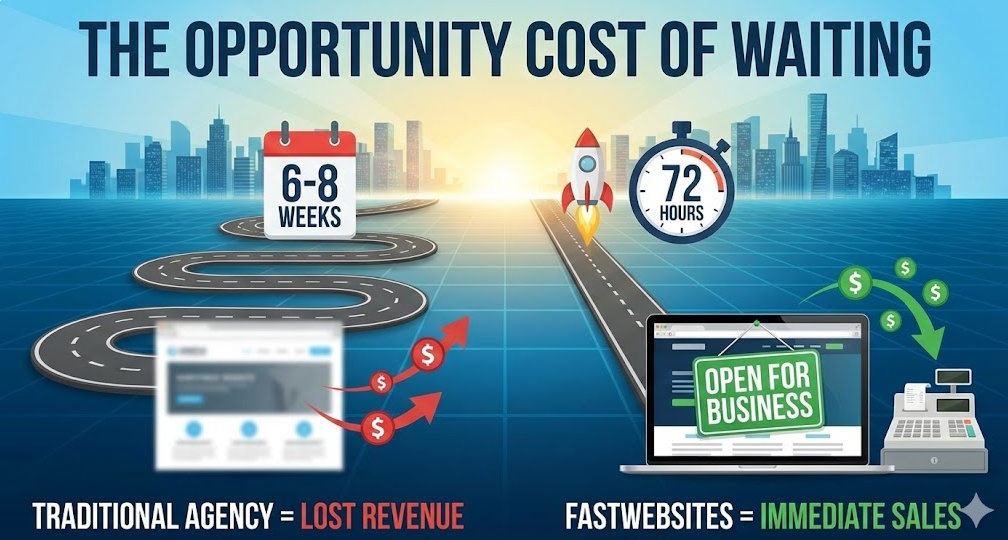
Time Is Money, and Waiting Is Expensive
Picture this: you're browsing an online store, ready to buy a pair of sneakers. The product page takes a few seconds to load, then the checkout button lags. After a minute of staring at a spinning wheel, you give up and head to a competitor's site. That simple act of impatience—a mere sixty seconds—just cost that first business a sale. Multiply that by every visitor who experiences the same delay, and you're looking at a serious drain on revenue.
This is the opportunity cost of waiting. It's not just about the time lost; it's about the potential gains you forfeit when you or your customers are forced to wait. In today's fast-paced digital world, speed is not just a luxury—it's a necessity. For Australian businesses, where consumers expect instant gratification, every millisecond of delay can translate into lost sales, diminished brand trust, and a competitive disadvantage.
In this article, we'll dive deep into the concept of opportunity cost as it applies to waiting, particularly in the context of website performance and business decision-making. We'll explore how slow loading times, delayed responses, and procrastination can quietly erode your bottom line, and we'll provide actionable strategies to help you reduce that cost and stay ahead of the curve. (Want to see fast sites in action? Check out Our Work).
What Is Opportunity Cost, Really?
Before we can talk about the cost of waiting, we need to understand the fundamental economic principle of opportunity cost. Simply put, opportunity cost is the value of the next best alternative that you give up when you make a choice. For example, if you spend $50 on a meal, the opportunity cost is that new book you could have bought instead. If you spend an hour watching TV, the opportunity cost is the hour you could have spent exercising or working on a side project.
The concept applies to every decision, big or small, and it's especially relevant when we talk about time. Unlike money, time is a non-renewable resource—once it's gone, you can't get it back. So when you or your customers wait for a slow website, you're not just losing seconds; you're losing the opportunity to do something more productive with that time.
In the context of business, opportunity cost often manifests as lost revenue, decreased efficiency, and missed growth opportunities. When a website loads slowly, visitors don't just wait—they leave. That's a direct opportunity cost: the sale you would have made if the page had loaded instantly. But there are also indirect costs: the damage to your brand's reputation, the negative word-of-mouth, and the lower search engine rankings that result from poor user experience.
Understanding opportunity cost is the first step to making better decisions. When you recognise that every second of delay has a price tag, you can start to prioritise speed and efficiency in a way that directly benefits your bottom line.
The Hidden Costs of a Slow Website
Your website is often the first point of contact between your business and potential customers. If it takes too long to load, you're essentially telling visitors that you don't value their time. And they'll respond accordingly—by leaving. Research from Google and other sources has consistently shown that as page load time increases from one to three seconds, the probability of a visitor bouncing increases by 32%. That number jumps to 90% for load times of five seconds or more.
But the costs go beyond just losing the initial visit. A slow website can have a ripple effect on your entire business:
Lost conversions: Every second of delay can reduce your conversion rate by up to 7%. For an e-commerce site generating $100,000 per month, that's $7,000 in lost sales every month.
Lower search rankings: Google uses page speed as a ranking factor. A slow site will likely rank lower in search results, meaning fewer organic visitors and less visibility.
Increased advertising costs: If you're running paid ads, a slow landing page will hurt your Quality Score, making each click more expensive and reducing your return on ad spend.
Damaged brand perception: Users associate slow websites with poor service and unreliability. Even if you fix the issue later, the negative impression may linger.
Higher bounce rates: Not only do visitors leave, but they may not come back. A study by Akamai found that 53% of mobile users abandon a site if it takes longer than three seconds to load.
These costs are not just theoretical—they're happening to businesses every day. The opportunity cost of waiting is real, and it's measured in dollars, not just seconds.
Real-World Examples: When Waiting Costs Big Money
Let's look at some concrete examples to illustrate the impact of waiting on businesses, both large and small.
The E-commerce Giant: In 2006, Amazon found that every 100 milliseconds of additional load time resulted in a 1% decrease in sales. While that might sound small, for a company generating billions in revenue, it translates to millions of dollars lost each year. Amazon's obsession with speed is well-known—they've even patented predictive loading to ship products before you click "buy."
The Travel Booking Site: Expedia discovered that a one-second improvement in page load time increased conversions by 2.3% and generated an additional $12 million in revenue annually. That's a direct opportunity cost of waiting—every second of delay was costing them real money.
The Local Australian Business: Imagine a small plumbing company with a website that takes 6 seconds to load on mobile. A homeowner with a burst pipe searches for "emergency plumber" on their phone. They tap your site, see the spinner, and within three seconds they've moved on to a competitor whose site loads instantly. You've lost a job that could have been worth $300, all because you didn't optimise your site.
These examples show that the cost of waiting isn't just a problem for huge corporations—it affects every business that relies on its website to generate leads or sales. The good news is that you can do something about it.
Calculating the Opportunity Cost for Your Business
So, how do you quantify the opportunity cost of waiting for your own business? While the exact numbers will vary, you can use a simple framework to estimate the impact.
Start with your current website performance. Tools like Google PageSpeed Insights, GTmetrix, or Pingdom can give you your page load time and performance score. Then, consider your traffic and conversion data. Let's walk through a calculation:
Determine your average monthly visitors. Let's say you get 10,000 visitors per month.
Find your current conversion rate. For this example, we'll use 2%.
Calculate your average order value. Suppose it's $80.
Now, look at the impact of speed. Research suggests that a 1-second delay can reduce conversions by 7%. So, if your site is currently 3 seconds, and you could get it to 2 seconds, you might see a conversion increase of about 7%.
Compute the revenue gain. With 10,000 visitors and a 2% conversion rate, you currently make 200 sales. A 7% increase would give you 214 sales—an extra 14 sales. At $80 each, that's $1,120 per month in additional revenue.
But that's just the direct impact. You also need to consider the lifetime value of those customers. If they return and make repeat purchases, the opportunity cost of waiting becomes even larger.
Additionally, factor in the cost of your time. If you're spending hours manually processing orders because your site is slow, or if you're losing productivity due to a sluggish dashboard, that's another opportunity cost. Time spent on slow processes is time not spent on growing your business.
Once you've calculated the potential gain, you can decide whether investing in website optimisation is worth it. In most cases, the return on investment is substantial—far exceeding the cost of implementing speed improvements.
Strategies to Reduce Waiting and Reclaim Lost Revenue
Now that you understand the cost, it's time to take action. Here are some practical strategies to make your website faster and reduce the opportunity cost of waiting for your customers. (We cover many of these technical details in our FAQ).
Optimise Images and Media
Large, unoptimised images are one of the most common causes of slow websites. Compress your images without sacrificing quality, use modern formats like WebP, and implement lazy loading so that images only load when they're about to appear on the screen. This can dramatically reduce page weight and improve load times.
Leverage Browser Caching
When a visitor returns to your site, their browser can store certain elements (like CSS, JavaScript, and images) to avoid re-downloading them. By setting appropriate cache headers, you can speed up repeat visits and reduce server load.
Use a Content Delivery Network (CDN)
A CDN stores copies of your site on servers around the world, so users download content from the server closest to them. For Australian businesses with international visitors, a CDN can significantly reduce latency and improve load times.
Minimise HTTP Requests
Each element on your page (script, stylesheet, image) requires an HTTP request. The more requests, the slower the page. Combine CSS and JavaScript files, remove unnecessary plugins, and simplify your design to reduce the number of requests.
Choose a Reliable Hosting Provider
Your hosting provider plays a crucial role in website speed. Shared hosting may be cheap, but it often means slower performance. This is why we include premium hosting in our transparent Pricing Packages. Consider upgrading to a virtual private server (VPS), dedicated hosting, or use a provider that specialises in high-performance infrastructure.
Implement Accelerated Mobile Pages (AMP) or Progressive Web Apps (PWA)
If your audience is predominantly mobile, AMP can make your pages load almost instantly, while PWAs offer a native-app-like experience. Both can drastically reduce load times and improve user experience.
By implementing these strategies, you'll not only reduce the opportunity cost of waiting for your customers but also improve your search rankings, increase conversions, and build a stronger brand.
The Opportunity Cost of Inaction: Why You Can't Afford to Wait
It's tempting to put off website optimisation. After all, there are always more pressing tasks—new products, marketing campaigns, customer service. But the opportunity cost of inaction is just as significant as the cost of a slow website. Every day you delay, you're losing potential revenue and allowing competitors to gain an edge.
Consider the long-term effects. If your site is slow, you'll rank lower in search results, which means fewer organic visitors. Over time, your competitors will dominate search engine results pages (SERPs), and it will become increasingly difficult to catch up. The cost of waiting isn't just about today's lost sales—it's about the compounding effect of lost opportunities over months and years.
Moreover, the digital landscape is always evolving. User expectations for speed are higher than ever, and they're only going to increase. By streamlining your digital presence with a proven development process now, you're future-proofing your business and ensuring that you're not left behind as technology advances.
Think about the decision-making process in your own business. Are there other areas where waiting is costing you? Perhaps you're delaying a crucial software upgrade, or you're slow to respond to customer inquiries. These are all forms of waiting that carry an opportunity cost. The key is to identify these bottlenecks and take decisive action.
Conclusion: Stop Waiting, Start Winning
The opportunity cost of waiting is a hidden tax on your business. Whether it's a slow website, delayed responses, or procrastination in making important decisions, every moment of waiting represents a missed opportunity. But by understanding this concept and taking proactive steps to reduce waiting, you can unlock significant revenue and growth.
Start by auditing your website's speed and calculating the potential gains from improvement. Then, implement the strategies we've outlined—optimise images, leverage caching, use a CDN, and choose the right hosting. These changes may require an upfront investment, but the return is well worth it.
Remember, in the digital age, speed is a competitive advantage. Your customers expect fast, seamless experiences, and they'll reward you with their loyalty and their money. Don't let the opportunity cost of waiting hold your business back. Take action today, and you'll be amazed at the difference it can make.
Ready to Stop Losing Customers to Slow Load Times?
If you're ready to eliminate the cost of waiting from your website, our team at Fast Websites is here to help. We specialise in high-performance, mobile-ready web solutions designed for Australian businesses—all built live in just 72 hours.
Don't let another slow second cost you a sale. Contact Us for a free speed audit or click below to Get Started and secure your lightning-fast website today!