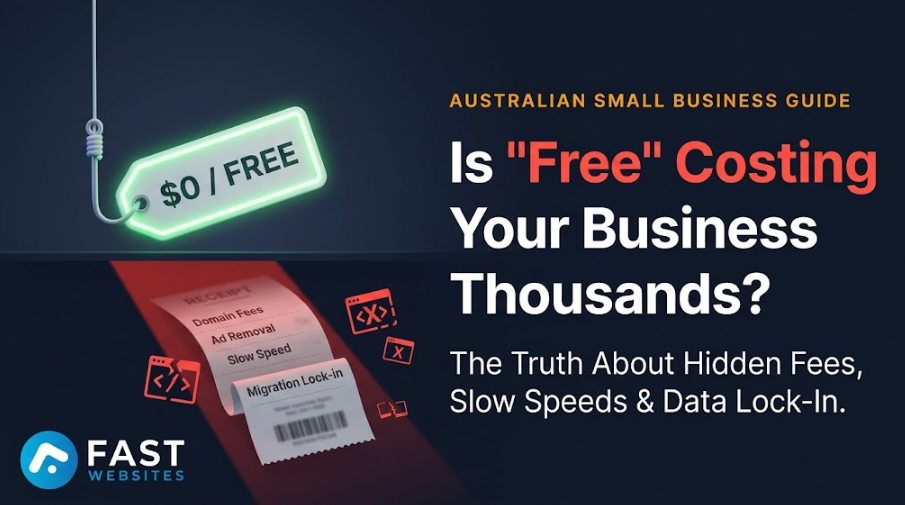
The Hidden Costs of Free Website Builders: What Aussie Businesses Need to Know
Free website builders lure you in with zero cost, but hidden fees, data ownership issues, and limited scalability can make them a false economy. Discover the true price of 'free' and why Australian businesses should consider paid alternatives.
Introduction
It’s a tempting pitch: “Build your website for free in minutes.” No upfront fees, no coding skills required, and a drag-and-drop interface that promises to have your business online before you finish your coffee. For Australian small business owners, sole traders, and startups watching every dollar, free website builders like Wix, Weebly, and WordPress.com sound like the perfect solution. But as the old saying goes, “There’s no such thing as a free lunch.”
Behind that shiny “Free” button lies a web of hidden costs—some financial, some strategic, and some that can quietly undermine your brand’s credibility and growth. In this article, we’ll pull back the curtain on the real price of using free website builders. We’ll explore how these platforms monetise you, limit your potential, and lock you into a cycle of upgrades and compromises. By the end, you’ll have a clear picture of whether a free builder is genuinely worth it for your Australian business—or whether it’s a false economy that could cost you far more in the long run.
The Allure of Free: Why We’re Drawn to Zero-Cost Solutions
Let’s start by acknowledging why free website builders are so appealing. For a new business, cash flow is tight. Every dollar counts, and the idea of avoiding a $1,000+ upfront web design bill is understandably attractive. Free builders also promise speed—you can have a basic site live in an afternoon, without needing to hire a developer or learn complex code.
But here’s the catch: these platforms aren’t charities. They’re businesses with shareholders, and they need to generate revenue. When you don’t pay with money, you pay with something else—often your data, your audience’s attention, or your long-term flexibility. Understanding this fundamental trade-off is the first step to seeing the hidden costs.
Data Ownership and Privacy: Your Website Isn’t Really Yours
One of the most significant hidden costs of a free website builder is the loss of control over your data. When you sign up for a free plan, you’re typically granting the platform broad rights to use your content, analytics, and customer information. Many free builders will display ads on your site, and they may also track your visitors’ behaviour to serve targeted advertisements—not just on your site, but across their network.
For Australian businesses, this raises serious privacy concerns. The Privacy Act 1988 (Cth) and the Australian Privacy Principles (APPs) impose strict obligations on how you handle personal information. If your free website builder is collecting and processing customer data in ways you don’t fully understand, you could be breaching your legal responsibilities—even if you didn’t intend to. The platform’s terms of service might allow them to sell or share data with third parties, and you have little say in the matter.
Moreover, you often don’t own the domain name. Free plans typically give you a subdomain like yourbusiness.wixsite.com or yourbusiness.wordpress.com. That means your online identity is tied to the platform’s brand, not yours. If you ever decide to leave, you lose any SEO equity built up on that subdomain, and you’ll have to start from scratch on a new domain.
Advertising and Branding: You’re the Product
When you use a free website builder, you’re not the customer—you’re the product. These platforms monetise your traffic by displaying ads on your pages. These ads can be intrusive, often appearing as banners, pop-ups, or even video ads that interrupt the user experience. Not only does this make your site look unprofessional, but it also drives visitors away. A study by Google found that 53% of mobile users abandon a site that takes longer than three seconds to load—and ads are a major culprit when it comes to slowing down your pages.
But the damage goes beyond user experience. Ads on your website can also undermine your credibility. Imagine a potential customer clicking through to your site only to see a flashing banner for a competitor or an unrelated product. It screams “amateur” and erodes trust. In Australia, where word-of-mouth and reputation are critical for small businesses, this can be devastating.
Furthermore, free builders often force you to use their branding—a small “Powered by Wix” or “Create your free website” badge. This not only looks unprofessional but also encourages your visitors to click away and build their own free site instead of doing business with you. Every click on that badge is a leak in your sales funnel.
Limited Functionality and Scalability: The Upgrade Trap
Free website builders are designed to be basic. They give you just enough features to get a simple site up, but the moment you need something more—a booking system, an online store, a custom contact form, or even just a custom domain—you’ll find yourself staring at a paywall. The “free” plan is essentially a teaser, and the real costs begin when you need to scale.
For example, to connect your own domain (e.g., www.yourbusiness.com.au) to most free builders, you’ll need to upgrade to a paid plan that can cost anywhere from $10 to $50 per month. Want to remove ads? That’s another paid tier. Need e-commerce functionality? That’s a premium feature that can cost $30-$100+ per month, plus transaction fees on every sale. These costs quickly add up, and before you know it, you’re paying more than you would have for a self-hosted website or a professionally designed site.
But the real problem is scalability. Free builders are limited in terms of storage, bandwidth, and the number of pages you can create. As your business grows, you’ll hit these limits and be forced to upgrade—often to a plan that’s still restrictive. And if you need custom functionality, such as integrating with Australian-specific payment gateways like Afterpay or Zip, you’ll find that many free builders don’t support these out of the box, or they charge extra for third-party integrations.
The upgrade trap is insidious because it lures you in with a low initial cost, then gradually increases your monthly outlay as your needs evolve. By the time you realise you’ve been paying for years, you might have spent thousands of dollars on a platform that still doesn’t give you the full control you need.
SEO and Performance: The Silent Killer of Your Online Visibility
Search engine optimisation (SEO) is the lifeblood of any business website. It’s how customers find you on Google, and it directly impacts your traffic and revenue. Unfortunately, free website builders are notoriously bad at SEO. They often generate messy, bloated code, have poor page load speeds, and limit your ability to customise meta tags, alt text, and URL structures.
Google’s algorithm prioritises fast, mobile-friendly, and technically sound websites. If your free builder site is slow (which is common because of the ads and heavy scripts), you’ll rank lower in search results, meaning fewer organic visitors. Worse, free builders often use generic, shared hosting infrastructure that can slow down your site during peak traffic times. A one-second delay in page load time can result in a 7% reduction in conversions—a cost that’s hard to quantify but very real.
Moreover, free builders often restrict access to your site’s source code, which means you can’t implement advanced SEO techniques like schema markup, custom redirects, or server-side caching. You’re stuck with whatever the platform offers, and that’s rarely enough to compete in the Australian market, where local businesses need every advantage to stand out.
E-Commerce and Transaction Fees: The Hidden Tax on Your Sales
If you’re planning to sell products or services online, a free website builder can quickly become a money pit. While some free plans allow you to set up a basic storefront, they typically charge transaction fees on every sale. For example, Wix’s free plan charges a 3% transaction fee on top of payment gateway fees. That might not sound like much, but for a small business with thin margins, it can eat into your profits significantly.
To avoid these fees, you’ll need to upgrade to a paid e-commerce plan, which can cost $30-$100+ per month. And even then, you’ll still have to pay payment gateway fees (e.g., PayPal, Stripe, or Square) that typically range from 1.75% to 3% per transaction. When you add it all up, you could be losing 5-7% of your revenue to fees—money that could be reinvested in your business.
Additionally, free builders often lack essential e-commerce features like abandoned cart recovery, inventory management, or advanced shipping options. These are crucial for running a successful online store in Australia, where customers expect seamless experiences and fast delivery. Without these tools, you’ll either have to pay for third-party apps (more costs) or lose sales to competitors who offer a better shopping experience.
Lock-In and Migration Nightmares: The Cost of Switching
One of the most overlooked hidden costs of free website builders is the difficulty of leaving them. Once you’ve built your site on a proprietary platform, moving to a different system is rarely straightforward. Free builders often use custom code and proprietary templates that don’t export cleanly. You might find yourself manually copying and pasting content, losing formatting, and having to rebuild your design from scratch.
This lock-in effect can be financially crippling. If you decide to switch to a more professional solution like WordPress.org or a custom-coded site, you’ll need to pay for a designer or developer to recreate your site. That cost could easily range from $1,500 to $10,000, depending on complexity. And if you’ve been relying on the free builder for years, you’ll also lose any accumulated SEO authority, social shares, and backlinks—all of which take time and money to rebuild.
Moreover, free builders often don’t allow you to export your customer data, orders, or email lists. This means you could lose valuable business intelligence and customer relationships if you decide to move. In the worst case, you might have to start your online presence from zero, which is a devastating setback for any business.
The Long-Term Cost Comparison: Free vs. Paid Solutions
Let’s put the numbers into perspective. Suppose you use a free website builder for your Australian business. After a year, you’re likely to have upgraded to a paid plan to get a custom domain and remove ads. That might cost you around $20-$40 per month, or $240-$480 per year. Add transaction fees if you sell online, and you’re easily looking at over $1,000 per year.
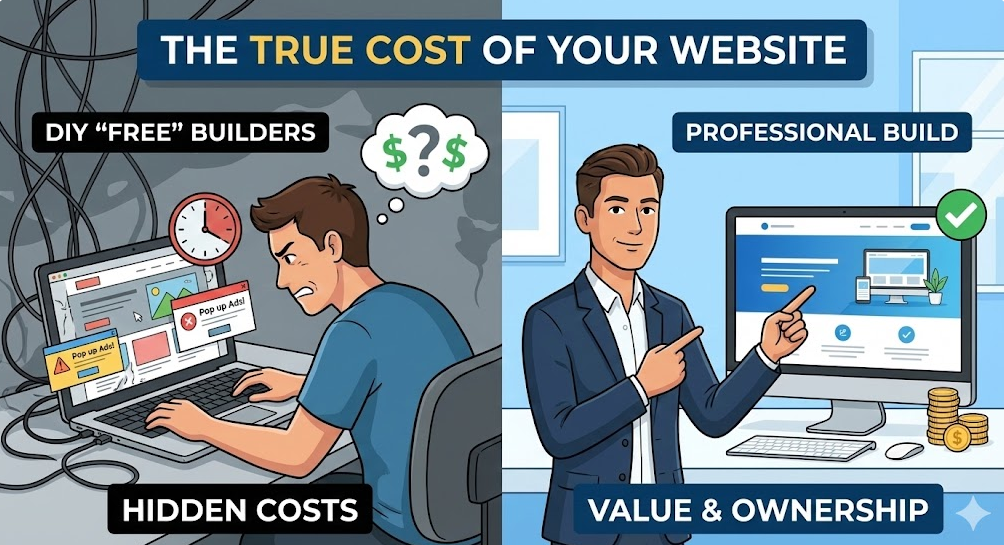
Now compare that to a professionally built, fixed-cost site. When you have a clear, transparent web design process and upfront pricing, you gain full control over your site, no ads, and unlimited scalability. If you hire an expert for initial setup, the one-time cost pays off rapidly. It is often significantly less than what you’d pay in ongoing "premium" fees and lost revenue to a restrictive free builder over three to five years.
With a proper site, you own everything—your content, your data, your domain, and your SEO. You can customise it to your heart’s content, integrate with any Australian payment gateway, and scale without hitting arbitrary limits. For businesses that are serious about their online presence, the long-term savings and flexibility of a paid solution far outweigh the initial investment.
Conclusion: Weighing the True Cost of "Free"
Free website builders are not a shortcut to online success—they’re a detour that often leads to a dead end. While they offer a low barrier to entry, the hidden costs—data ownership, advertising, limited functionality, poor SEO, transaction fees, and lock-in—can quickly outweigh the savings. For Australian businesses that want to build a credible, scalable, and profitable online presence, investing in a proper web solution is almost always the smarter choice.
That doesn’t mean you need to spend a fortune. There are highly affordable options tailored for small businesses that provide reliable hosting, professional design, and top-tier SEO right out of the box. The key is to think long-term and understand that your website is an asset, not an expense. Every dollar you save today by using a free builder could cost you tenfold in lost customers, wasted time, and missed opportunities tomorrow.
Before you click that “Free” button, ask yourself: What is my business worth? If the answer is “a lot,” then treat your website with the respect it deserves. Invest in a solution that gives you ownership, control, and room to grow. Your future self—and your bottom line—will thank you.
Stop Renting, Start Owning Your Website Today
Tired of hitting paywalls, battling slow load times, and worrying about hidden fees? At Fast Websites, we build professional, mobile-ready, and SEO-optimised platforms that you actually own 100%. With fixed pricing from $899, no agency bloat, and lightning-fast delivery in just 72 hours, we make true ownership affordable and effortless.
Ready to invest in a website that scales with your Aussie business? Check out our straightforward Pricing Options or Get Started Now!